
Drainage Aggregate
2 Inch Minus Rock
1½" to 2¼" Screened · Unwashed · French Drains · Retaining Walls · Utility Bedding
Retail Price
$28/ton
~55–70 sq ft/ton
Coverage at 12" depth
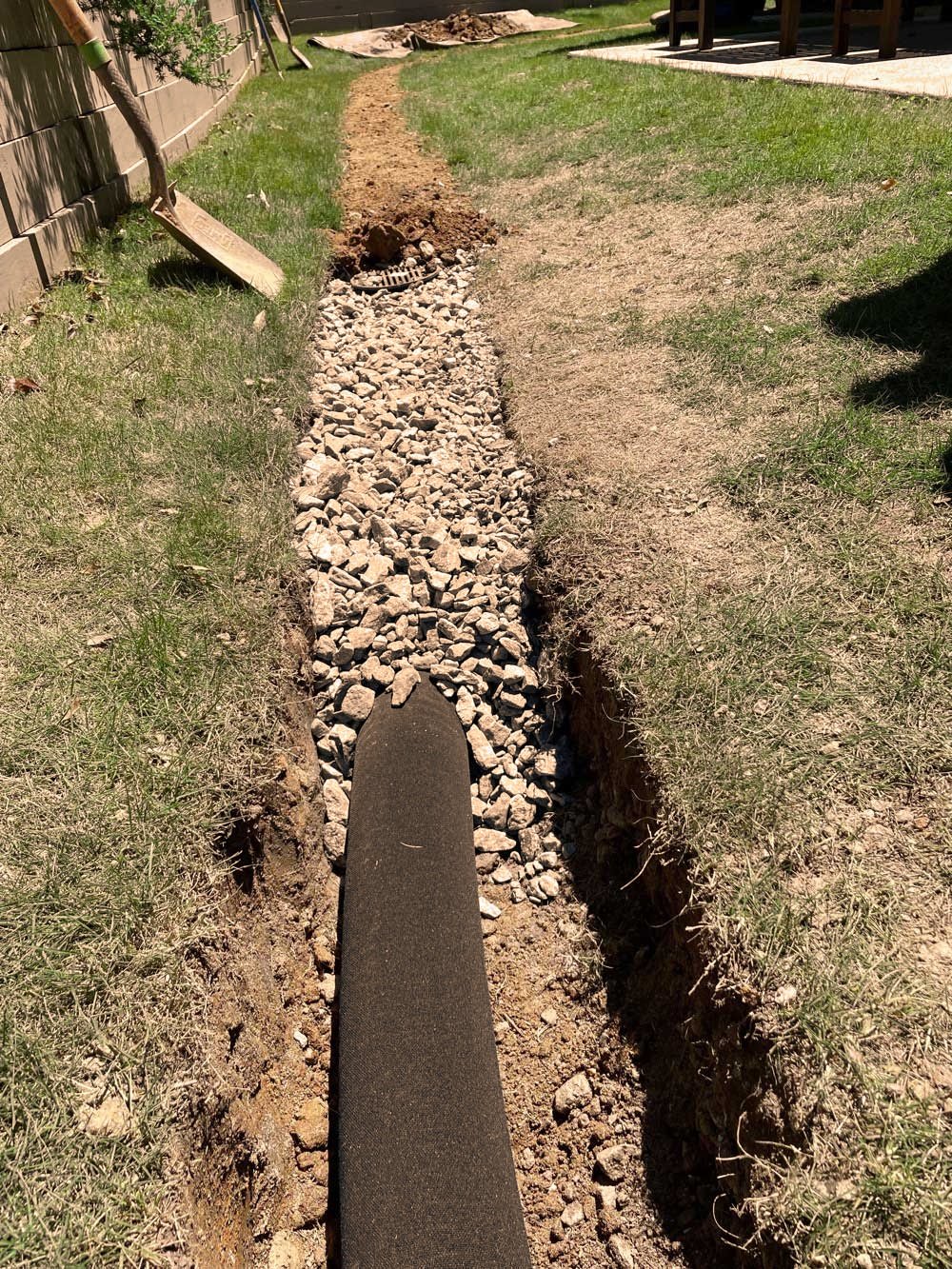
2 Inch Minus Rock — French Drain Installation, Teller County CO
What Is 2 Inch Minus Rock?
Water is the most persistent enemy of Colorado mountain property — it pools against foundations, saturates soils, pushes retaining walls off their footings, and turns driveways into mud every spring. 2 Inch Minus Rock is one of the most effective and versatile tools available to property owners and contractors for intercepting, redirecting, and managing that water before it causes expensive damage.
The name is straightforward: all rock that passes through a 2-inch screen, producing particles that range from approximately 1½ to 2¼ inches in size. It is unwashed and screened at the pit. Like our 4 Inch Minus, this product is engineered to stay open rather than compact. The angular, irregular particles sit against each other with significant void space between them — and it is through those voids that water moves rapidly downward and along drainage pipe.
What makes 2 Inch Minus the preferred size for most residential drainage applications is the balance it strikes: particles large enough to maintain substantial void space and flow rate, while small enough to handle, spread, and work into tight trench installations without bridging or creating large air pockets.
Where Is 2 Inch Minus Rock Used?
Of all MCG's aggregate products, 2 Inch Minus has the widest range of residential drainage applications. If your project involves moving water away from something you want to stay dry, this rock is likely part of the solution.
- French Drains — The most common use. A perforated pipe is laid in a geotextile-lined trench and surrounded with 2 Inch Minus. Water enters through the rock, flows into the pipe, and is conveyed downslope away from foundations, driveways, and structures.
- Foundation Perimeter Drainage — Installed around a home's foundation perimeter, 2 Inch Minus intercepts groundwater and roof runoff before it can saturate the soil adjacent to footings.
- Retaining Wall Backfill Drainage — Every retaining wall must have at least 12 inches of free-draining aggregate behind it. Water that accumulates behind a wall builds hydrostatic pressure that can cause bulging, cracking, and outright failure.
- Utility Pipe Bedding — Water lines, sewer laterals, conduit, and drainage pipe all perform better when bedded in free-draining aggregate rather than compacted soil.
- Dry Creek Beds — Lined with 2 Inch Minus, a dry creek bed manages stormwater runoff from a slope or swale with a natural, landscape-appropriate appearance.
- Driveway Drainage Swales — Roadside and driveway swales filled with 2 Inch Minus handle runoff from the driving surface while resisting erosion.
- Patio & Walkway Sub-drainage — Placed beneath flagstone patios and walkways, a drainage layer of 2 Inch Minus allows water to percolate away rather than pooling under pavers.

2 Inch Minus Rock — Retaining Wall Drainage Backfill, Park County CO
Installing 2 Inch Minus Rock — Practical Guidance
For a standard residential French drain — a trench 24 inches wide, 24 inches deep, and 100 feet long — plan for approximately 14–18 tons of 2 Inch Minus. For retaining wall backfill, calculate wall length × 1-foot drainage zone depth × wall height, convert to cubic feet, and divide by 21 for approximate tons. A wall 40 feet long and 4 feet high needs roughly 12–15 tons behind it.
- Minimum drain slope — Colorado drainage professionals recommend a minimum 1% slope — a 1-inch drop for every 10 feet of pipe run. A 2% slope is better wherever achievable.
- Perforated pipe orientation — Holes should always face downward. Water collects at the bottom of the drainage aggregate zone and enters the pipe through the lower perforations.
Colorado Clay Soil Tip — Never Skip the Fabric
Teller, Park, Fremont, Jefferson, Douglas, El Paso, and Pueblo County soils are notoriously high in clay content. Clay particles are extraordinarily fine — over time and with water movement, they migrate into drainage aggregate and fill the void space that makes the rock work. Always line your trench with non-woven geotextile filter fabric before placing any rock. A French drain without fabric in Colorado clay will eventually fail as fines fill the voids. With fabric, the system remains effective for decades.
Retaining Walls 4 Feet and Taller
Any retaining wall 4 feet tall or greater requires both drainage aggregate backfill AND a perforated drain pipe system. Walls of this height can experience catastrophic failure without adequate drainage. Colorado typically requires a building permit and engineered plans for walls over 4 feet — confirm permit requirements with Teller or Park County building departments before construction.
Technical Specifications
| Property | Value / Range | Notes |
|---|---|---|
| Particle Size Range | 1½" – 2¼" | Passes 2" screen; retained on 1½" |
| Material Type | Crushed granite/gneiss | Native Colorado pit rock, angular |
| Washed / Unwashed | Unwashed | Screened; light crusher dust on surface |
| Void Ratio (approx.) | 30–38% | Uncompacted; high drainage flow rate |
| Unit Weight (loose) | ~95–110 lbs/cu ft | Approx. 1.25–1.45 tons per loose cu yd |
| Min. Drain Slope | 1% (1" per 10 ft) | 2% preferred wherever achievable |
| Recommended Pipe | 4" perforated PVC/HDPE | Holes down; geotextile sock strongly recommended |
| Retail Price | $28/ton | Call for contractor/volume pricing |
| Delivery Method | Tandem or End Dump | Tandem for tight mountain access; End Dump for volume |
Order 2 Inch Minus Rock
Call Tess to place your order, confirm availability, and schedule delivery.