
Divide, Colorado · Pit-Fresh · CDOT-Compliant
Our Pit Products
Seven premium aggregate materials screened and graded fresh from our Divide, Colorado pit — delivered to Teller, Park, Fremont, Jefferson, Douglas, El Paso, and Pueblo County. Click any product below to learn more, or call Tess at (719) 686-1566 to place your order.

Aggregate Base Course · CDOT Spec · #200 to ¾"
Class 6 Road Base
Call for contractor pricing
If there's one material that defines Colorado mountain property construction, it's Class 6 Road Base. This carefully engineered blend of crushed rock, gravel, sand, and fines — ranging from #200 dust to ¾-inch pieces — is the gold standard foundation material for driveways, private roads, parking areas, and as a base layer under asphalt or concrete.
What makes it exceptional is how the angular, crushed particles interlock under compaction into a dense, rigid matrix that sheds water, distributes heavy loads evenly, and stands up to Colorado's brutal freeze-thaw cycles year after year.
MCG's Class 6 meets CDOT specifications and is sourced fresh from our Divide pit — not aged in a stockpile. A stamped soils report is available on request, ideal for permit submittals and contractor quality control.

Drainage · Septic Fields · Construction Pads
4 Inch Minus Rock
4 Inch Minus Rock is the workhorse of Colorado construction sites — the material that makes the messy, demanding jobs possible. This unwashed, screened aggregate ranges from 2½ to 4 inches in size, providing the large void space needed for high-performance drainage and the mass needed for heavy-duty applications.
Its most common use across Teller and Park County is septic system leach fields, where it surrounds perforated distribution pipe and allows effluent to percolate into native soil across a large surface area. Colorado county health departments routinely specify this size for conventional septic installations.
It's also ideal for construction entrance tracking pads — laid thick at a job site entrance, it traps mud from truck tires before they hit the public road, keeping sites compliant with stormwater regulations.

Drainage · Foundation · Utility Bedding
2 Inch Minus Rock
Water is the enemy of every Colorado mountain property — and 2 Inch Minus Rock is one of the most effective tools available to control it. This unwashed, screened aggregate runs from 1½ to 2¼ inches in size, hitting the sweet spot between flow rate and stability that makes it ideal for drainage applications.
French drains are the most common use: a trench is excavated, lined with geotextile fabric, filled with 2 Inch Minus, and a perforated pipe is buried within it to intercept groundwater or surface runoff and redirect it safely away from foundations, driveways, and structures.
Beyond French drains, 2 Inch Minus serves as dry creek bed lining that manages storm runoff with a natural appearance, as bedding for underground utilities where free drainage around the pipe is required, and as a coarse drainage layer beneath patios and flagstone walkways.

Landscaping · Drainage · Water Features
Unwashed River Rock
All four sizes — same price
River Rock brings a natural, polished beauty to Colorado landscapes that no other aggregate can match. These smooth, rounded stones — shaped by centuries of water action — are available in three sizes: 1 inch, 2 inch, and 4 inch, each suited to different applications and visual scales.
The 1-inch size is perfect for tight spaces, decorative ground cover beneath shrubs and trees, and smaller water features where a fine, uniform texture is desired. The 2-inch size is the most versatile — beautiful as a dry stream bed lining, effective as a drainage medium in landscape swales, and comfortable underfoot on garden paths.
The 4-inch size makes a bold visual statement in larger landscape features, at the toe of retaining walls, and in erosion control applications along slopes and drainage channels. Unlike crushed angular aggregate, river rock's smooth surface doesn't compact, making it excellent wherever you need drainage combined with aesthetics.

Site Preparation · Grading · Bulk Fill
Fill Dirt
Fill dirt is the most economical way to move grade — raising low spots, filling excavations, building berms, and establishing site elevation before finish materials go on top. At $14 per ton, it's priced for projects where volume matters more than purity.
MCG's fill dirt is pit-run material and may contain rocks, gravel, concrete chunks, roots, and general non-hazardous pit debris. It is appropriate for non-structural bulk fill applications, but is NOT appropriate for structural foundations, engineered fill, septic backfill, or any application requiring clean, tested fill.
A popular pairing: use fill dirt to bring a site up to rough grade economically, then cap with 6 inches of compacted Class 6 Road Base for the final drivable surface.

Driveways · Parking Areas · Road Surfaces
Asphalt Millings
Asphalt Millings — also called recycled asphalt pavement, or RAP — are one of the most practical and economical surface materials for Colorado driveways and parking areas. At $20 per ton, they deliver near-pavement performance at a fraction of the cost of new asphalt.
Millings are produced by grinding up existing asphalt pavement, leaving behind a material with a unique quality: the residual bitumen binder reactivates under heat and traffic, causing the millings to gradually bind together and form a semi-solid, hardened surface over time.
The result is a driveway that starts as a loose gravel-like surface and progressively firms up with each warm Colorado day and each vehicle pass — ultimately resembling a low-cost paved surface. Their dark color gives a finished, neat appearance many property owners prefer over raw aggregate.
Retaining Walls · Erosion Control · Landscaping
1–4 Foot Boulders
Larger specimens: call for pricing
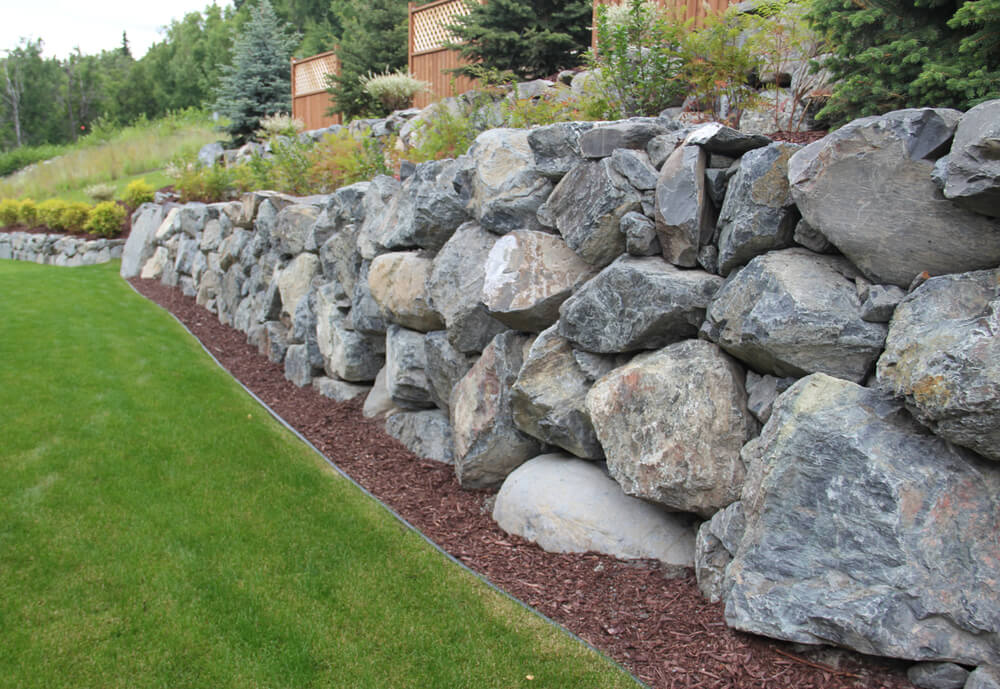
Nothing anchors a Colorado mountain landscape quite like natural stone boulders. MCG's 1 to 4-foot natural Colorado boulders are pit-sourced, rugged, and perfectly matched to the Rocky Mountain terrain — the kind of stone that looks like it belongs because it does.
Structurally, boulders are the definitive solution for retaining walls on sloped properties, where their sheer mass holds back hillsides without footings, mortar, or the engineered systems that smaller block walls require. A well-built boulder retaining wall is virtually maintenance-free, improves with age as vegetation fills in the gaps, and blends into the natural landscape in ways concrete and block simply cannot.
Beyond retaining walls, boulders provide erosion control along drainage channels and slopes, serve as large-scale landscape features and property entry markers, create natural seating and outdoor gathering areas, and function as traffic control barriers for parking and staging areas.