
Coarse Drainage Aggregate
4 Inch Minus Rock
2½" to 4" Screened · Unwashed · Septic · Tracking Pads · Drainage
Retail Price
$38/ton
~55–65 sq ft/ton
Coverage at 12" depth
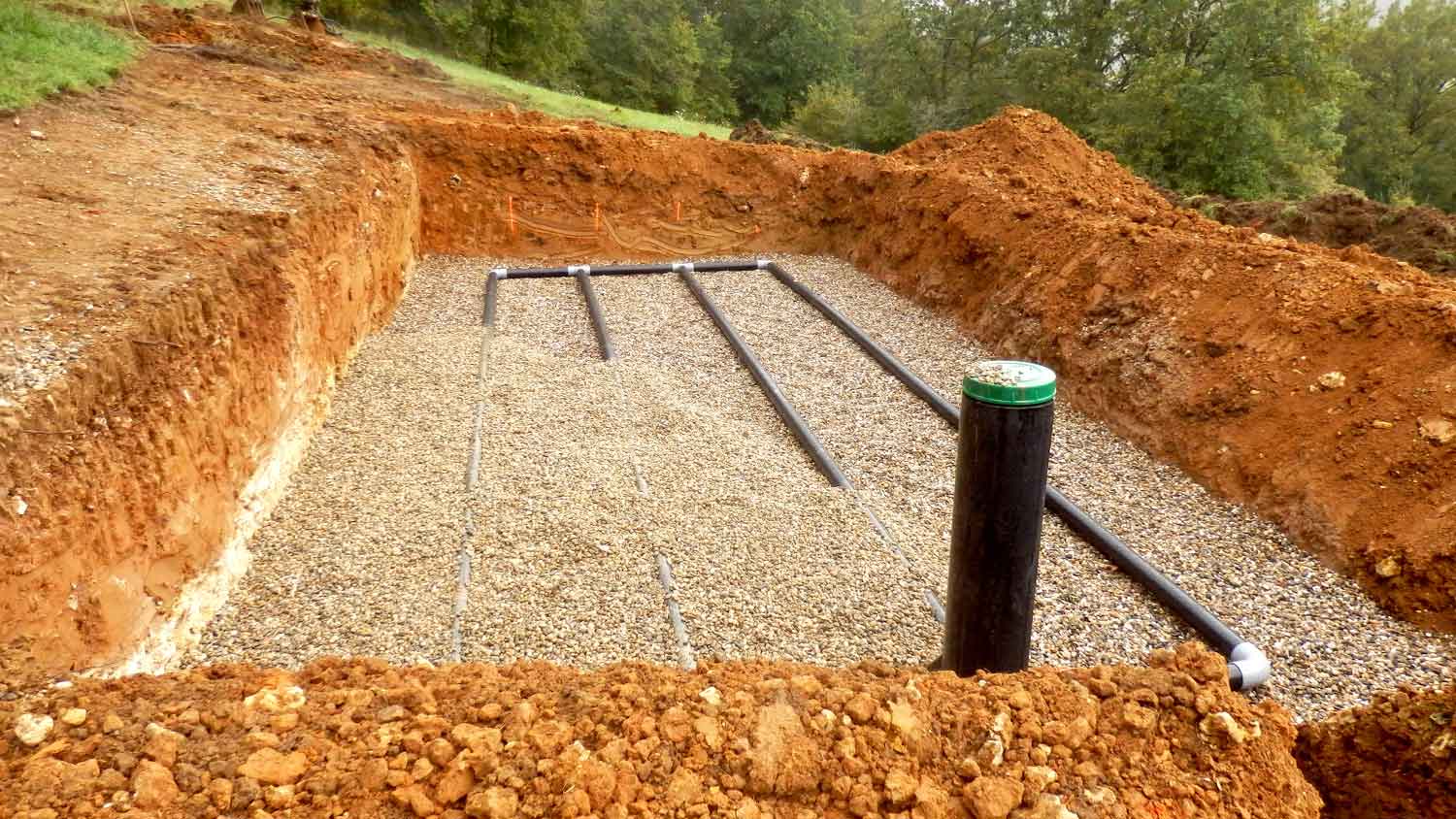
4 Inch Minus Rock — Septic Leach Field Installation, Teller County CO
What Is 4 Inch Minus Rock?
If you're building a new home or adding a structure to a rural Colorado property, you're almost certainly going to need 4 Inch Minus Rock at some point — whether for your septic system, your construction entrance, or both. It's one of the most-ordered products at Mule Creek Gravel, and for good reason: it does jobs that no other aggregate can do quite as well.
The name describes it simply: all rock pieces that pass through a 4-inch screen, ranging from about 2½ inches up to 4 inches in size. It's unwashed and uncoated — what comes out of the pit after screening is what gets delivered to your project. The large, angular pieces create substantial void space — empty air gaps that water moves through quickly and freely.
Unlike Class 6 Road Base, which is engineered to compact into a solid mass, 4 Inch Minus is engineered to stay loose. It resists compaction, holds its void structure under load, and keeps water moving even when buried under several feet of soil — which is exactly what a septic leach field or a stormwater tracking pad needs it to do.
Where Is 4 Inch Minus Rock Used?
This product has a narrower — but critically important — set of applications. When one of these jobs comes up, there's usually no substitute.
- Septic System Leach Fields — The primary use in Teller, Park, Fremont, Jefferson, Douglas, El Paso, and Pueblo County. 4 Inch Minus surrounds perforated distribution pipe in leach trenches, providing the drainage void space required by Colorado Regulation 43 for on-site wastewater treatment systems.
- Construction Entrance Tracking Pads — Also called a Vehicle Tracking Control (VTC), a thick pad of 4 Inch Minus at a job site entrance is required under CDOT's stormwater BMP guidelines for construction sites that disturb more than one acre.
- Retaining Wall Core Fill — Behind large boulder or block retaining walls, a free-draining core of coarse rock prevents hydrostatic water pressure from building up behind the wall.
- Erosion Control Along Channels — The mass and size of 4 Inch Minus makes it effective for lining drainage ditches, culvert outlets, and swale channels where fast-moving water would displace smaller rock.
- Sub-base Drainage Layer — In situations where groundwater is close to the surface, a thick layer of 4 Inch Minus below a gravel driveway base creates a capillary break.
- Culvert Outlet Protection — Placed at the discharge point of a culvert, coarse rock dissipates the energy of flowing water and prevents scour of the surrounding soil.

4 Inch Minus Rock — Construction Entrance Tracking Pad, Park County CO
Using 4 Inch Minus Rock — Practical Guidance
Coverage varies significantly depending on application. For a septic leach field trench, Colorado guidelines require at least 6 inches of drainage rock below the distribution pipe and 2 inches above it — so a trench 24 inches wide and 100 feet long needs approximately 8–10 tons. For a construction tracking pad at CDOT's minimum dimensions (12 feet wide × 70 feet long × 6 inches deep), plan for 25–30 tons.
- Always use geotextile fabric — Whether you're installing a septic trench or a construction tracking pad, always line the excavation with geotextile separation fabric before placing 4 Inch Minus. In a septic trench, the fabric prevents fine soil particles from migrating into the rock over time and clogging the drainage void space.
Do NOT Compact 4 Inch Minus
Unlike road base, 4 Inch Minus should never be mechanically compacted. Compaction destroys the void space that makes it work. Simply dump it, spread it to the correct depth with a rake or excavator bucket, and leave it alone. The rock will settle slightly under its own weight, which is normal and acceptable.
Technical Specifications
| Property | Value / Range | Notes |
|---|---|---|
| Particle Size Range | 2½" – 4" | Passes 4" screen; retained on 2½" screen |
| Material Type | Crushed granite/gneiss | Native Colorado pit rock, angular |
| Washed / Unwashed | Unwashed | Screened only; fines may be present on surface |
| Void Ratio (approx.) | 35–40% | Uncompacted; supports high hydraulic flow rate |
| Unit Weight (loose) | ~90–100 lbs/cu ft | Approx. 1.2–1.35 tons per loose cubic yard |
| Compaction | Do NOT compact | Compaction destroys drainage void space |
| Geotextile Required | Yes — always recommended | Prevents fines migration; extends system life |
| Delivery Method | End Dump preferred | High-lift discharge handles weight and bulk |
CDOT Vehicle Tracking Pad Specifications
Under CDOT's Erosion Control & Stormwater Quality Guide (Chapter 5, Section 208), aggregate-based Vehicle Tracking Control systems must meet the following minimum design criteria:
- Pad Width — Minimum 12 feet (full width of access point)
- Pad Length — Minimum 70 feet (provides approximately four full tire rotations)
- Aggregate Depth — Minimum 6 inches, placed over geotextile class 2 fabric
- Permit Trigger — Required under CDPHE COR400000 for sites disturbing ≥1 acre
- Maintenance — Must be inspected and redressed with fresh rock when sediment accumulation compromises effectiveness
Septic Installation Tip — Colorado Regulation 43
Colorado Reg. 43 requires dispersal trenches to contain drainage media sized ¾ inch to 2½ inches for standard installations. For projects specifying the larger 2½–4 inch range, always confirm your county's specific requirements with your licensed engineer or local health department before ordering.
Order 4 Inch Minus Rock
Call Tess to place your order, confirm availability, and schedule delivery.