
Natural Colorado Stone
1–4 Foot Boulders
Pikes Peak Granite & Gneiss · Pit-Sourced · Hand-Pick Available · Retaining Walls · Landscaping · Erosion Control
Retail Price
$50/ton
Larger boulders — call for special pricing
1–2 per ton
At 3–4 ft · 4–6 per ton at 2–3 ft
Natural Colorado Boulders — Retaining Wall & Landscaping, Teller County
Colorado's Own Stone
Few landscape materials have the visual impact — or the staying power — of a natural Colorado boulder. MCG's boulders are one of our most popular products, and customers who use them consistently tell us the same thing: when the project is finished, neighbors ask where the stone came from. That's because this is genuinely local stone — Pikes Peak granite and associated gneiss, sourced directly from our Divide pit in Teller County, the same rock formation that defines the dramatic landscape of Colorado's central Front Range.
Pikes Peak granite is a 1.08-billion-year-old Precambrian syenogranite — one of the oldest exposed rock formations in the American West. Its signature coarse-grained texture, large feldspar crystals, and warm tones ranging from gray to buff to russet are the direct result of ancient magma cooling slowly deep within the earth, then being uplifted and exposed by millions of years of erosion.
MCG's boulders range from 1 to 4 feet in their longest dimension, priced at $50 per ton. Boulders larger than 4 feet are also available by special arrangement — see the Oversized Boulders section below for full details.
Hand-Pick Selection — Strongly Encouraged
Boulders are not a standardized product. Every stone in our pit is unique in shape, color, texture, face angle, and character. We strongly encourage customers to come to the pit and hand-pick their boulders before delivery or self-haul. Our pit is open Monday–Thursday 7am–4pm and Friday 7am–Noon. Call ahead so we can have staff available to assist.
Boulder Size & Weight Guide
MCG's granite and gneiss boulders weigh approximately 165–175 lbs per cubic foot. Because boulders are irregular in shape, the table below gives realistic weight ranges rather than precise values — use them as planning guidance and round up for safety.
Equipment Planning Rule of Thumb
Any boulder over 500 lbs (roughly 1½ feet) requires mechanical assistance to move. A 2-foot boulder at 700–900 lbs can be handled by a capable skid steer with forks or grapple bucket. Boulders 2½ feet and larger typically require a track excavator with a grapple or thumb attachment for safe, precise placement. Never attempt to hand-move boulders above 300 lbs — the risk of crush injury is serious. Plan your equipment before the load arrives.
| Boulder Size | Est. Weight Range | Approx. Count per Ton | Typical Use |
|---|---|---|---|
| 1 ft | 80–175 lbs | 11–25 boulders | Garden accents, small edging, dry creek beds |
| 1½ ft | 250–500 lbs | 4–8 boulders | Landscape borders, low retaining tiers, garden features |
| 2 ft | 500–900 lbs | 2–4 boulders | Retaining walls, entry features, erosion control |
| 2½ ft | 900–1,500 lbs | 1–2 boulders | Retaining walls, large landscape anchors, property markers |
| 3 ft | 1,500–2,500 lbs | 1–2 boulders | Statement retaining walls, heavy erosion control, feature boulders |
| 3½ ft | 2,200–3,500 lbs | ~1 boulder | Large retaining walls, dramatic focal points, access control |
| 4 ft | 3,000–4,500 lbs | ~1 boulder | Major retaining features, traffic barriers, monumental landscaping |
| 4+ ft (Oversized) | 4,500 lbs–10,000+ lbs | Call for availability | Monumental features, heavy erosion control — special hauling required |
What Boulders Are Used For
MCG boulders appear in a remarkable range of finished projects across Teller, Park, Fremont, Jefferson, Douglas, El Paso, and Pueblo County.
- Landscape Retaining Walls — Boulder walls are the most-requested application. Their mass provides structural resistance without footings or mortar, they drain naturally, and they improve visually as moss and lichen colonize them over time.
- Erosion Control on Slopes — Boulders placed along swales, drainage channels, and steep slopes resist water erosion far better than any other aggregate. Their weight keeps them in place even during Colorado's heavy spring snowmelt events.
- Property Entry Markers & Focal Points — A single well-placed 3–4 ft boulder at a driveway entrance or garden corner anchors the landscape and gives properties a signature that visitors notice and remember.
- Natural Seating & Gathering Areas — Flat-faced boulders in the 2–3 ft range make excellent natural seating around fire pits, along pathways, and at overlooks. Zero maintenance, zero replacement, and they look better every year.
- Traffic Control & Property Boundaries — Boulders placed at the edge of driveways, parking areas, and property lines are more effective than any fence for keeping vehicles where they belong, and far more attractive than concrete barriers.
- Dry Creek Beds & Water Feature Surrounds — Larger boulders anchor the structure of dry creek beds and pond surrounds, combining with smaller river rock to create the natural, layered appearance of a genuine Colorado streambed.
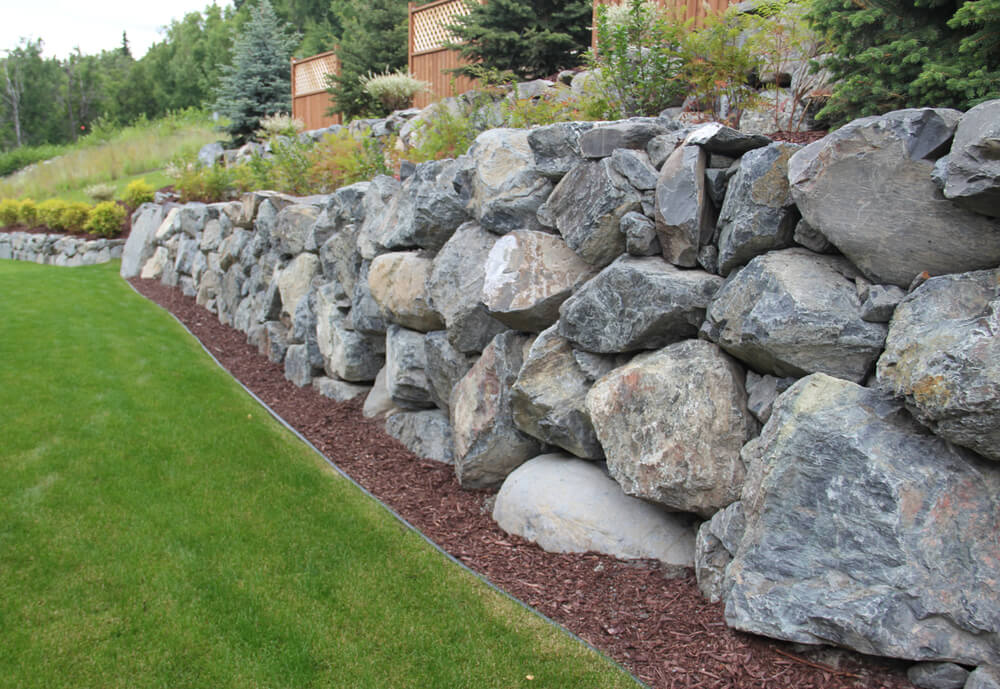
Natural Colorado Boulder Wall — Divide Pit Stone, Teller County
Retaining Wall Planning — Know Before You Build
Boulder retaining walls are one of the most beautiful and permanent structures you can add to a Colorado mountain property. They can also be one of the most consequential to get wrong.
- Under 2 feet — Low landscape walls — Generally manageable for capable DIYers with appropriate equipment. Focus on a compacted gravel base, good drainage rock behind the wall, and boulders set with their widest face down for stability. Use 2 Inch Minus Rock behind the wall for drainage.
- 2–4 feet — Mid-height retaining walls — Most residential applications fall here. These walls are very achievable with a skid steer and careful execution, but good planning matters: compacted base, 12+ inches of drainage rock behind, a drain pipe at the footing, and boulders battered (leaning slightly back into the slope) at roughly 1 inch per foot of height.
- Over 4 feet — Structural walls — In most Colorado jurisdictions, any retaining wall over 4 feet in height requires a building permit and typically engineered plans from a licensed civil or geotechnical engineer. The consequences of a structural wall failure are serious. Please engage an engineer for walls of this height.
Drainage Behind All Walls
The single most common cause of boulder wall failure — at any height — is inadequate drainage. Water trapped behind a wall builds hydrostatic pressure that eventually pushes even large boulders forward. Always install 2 Inch Minus Rock backfill and a perforated drain pipe at the wall base.
Delivery — What to Expect & How to Prepare
Boulder deliveries are made by End Dump Truck. The truck backs into your site and raises the bed, depositing the load in a stationary dump or while moving slowly forward. Boulders are heavy and they roll — once the bed tips, the material moves as a mass and individual boulders will roll, shift, and come to rest wherever gravity takes them.
- MCG Delivers by End Dump Truck — The most common option. We load, haul, and dump. You prepare the site, have your equipment ready, and take it from there. Call Tess to schedule. Rate is $135/hour for the End Dump Truck.
- Self-Haul with Your Equipment — If you have appropriate heavy commercial hauling equipment, you are welcome to come to the pit and load your own boulders. Standard truck beds and light-duty trailers are not appropriate for boulder hauls due to weight and bed damage risk.
- Customer-Contracted Licensed Hauler — You arrange and pay your own licensed hauling contractor; MCG loads them at the pit. Call Dominic to arrange.
Prepare Your Site Before Delivery — Boulders Will Roll
The area where the truck dumps must be prepared in advance to control where boulders come to rest. Use railroad ties, timber barriers, or heavy equipment as a backstop at the far end of the dump zone. After delivery, all boulder placement to their final location is the customer's or contractor's responsibility. Plan for a skid steer, mini excavator, or excavator to be on-site or available promptly after delivery.

Boulder Delivery & Placement — Excavator with Grapple, Park County CO
Oversized Boulders — Over 4 Feet
For the right project, a truly massive boulder — 5, 6, or more feet in its longest dimension — creates a statement nothing else can match. MCG does have oversized specimens in the pit from time to time, and we are happy to work with customers who want them. But the logistics of moving and placing these stones require a level of planning and specialized equipment that goes well beyond a standard delivery.
A 5-foot granite boulder can weigh 6,000–10,000 lbs or more. Standard dump trucks cannot safely carry specimens above approximately 25–30 tons total load. Very large boulders may require a lowboy or flatbed trailer rated for the load, a licensed heavy hauler with appropriate permits, and in some cases an oversize load permit from CDOT. The customer is responsible for arranging and paying for all transportation from the pit to the site.
Oversized Boulders — Call First
Oversized specimens are not a guaranteed inventory item. Availability depends entirely on what the pit has produced. Call Dominic at (719) 374-0381 to discuss what is currently available and whether it suits your project before making any other arrangements. Oversized specimens are priced individually and by arrangement — not at the standard $50/ton rate.
Order 1–4 Foot Boulders
Call Tess to place your order, confirm availability, and schedule delivery.
Hand-pick visits welcome — call ahead so staff can assist. 21094 CO-67, Divide, CO 80814